
Rajasthan in focus
Q2 2025 updates


“Planting in the desert” - we get that often when people hear that we are working in Rajasthan, even from ‘expert’ forestry specialists from other regions. With Rajasthan, they often picture the stark, lifeless sand dunes of the Thar Desert. Then we qualify that we plant in southern Rajasthan. This region, particularly around Udaipur, receives different rainfall patterns and has soil conditions that can support vegetation with proper water management and species selection. 60% of the state is desert (with its own ecological richness, but that’s not relevant here), but the other 40% is has rich biodiversity and ecological history. The Aravalli Range is fertile and home to dry deciduous forests and tropical dry broadleaf forests. These two maps of ecosystem distributions, one from 1971 and the other from 2011 paint a clearer picture.


Works of Arid Forest Research Institute, Jodhpur encompasses ecological complexity of these tropical dry deciduous forests, showing that arid and semi-arid landscapes can be successfully restored with appropriate techniques and species selection. There is a need for further adoption of this and the Indian Government’s Aravalli Green Wall project spanning Gujarat, Rajasthan and Haryana brings focus to this region.
The Great Green Wall Initiative in Africa's Sahel region demonstrates this principle on a massive scale, showing how strategic intervention can reverse desertification and restore ecosystems across thousands of kilometres of degraded land. In this podcast Nate Hagens and Andrew Milison discuss large-scale greening in the Sahel region supported by the UN World Food Program. Like our work in southern Rajasthan, these projects succeed by working with natural water cycles, selecting drought-resistant native species, and implementing soil conservation techniques that gradually transform barren land into productive ecosystems. The "impossible" becomes possible when we move beyond surface impressions and apply ecological understanding to restoration efforts.
Restored Sites in Rajasthan
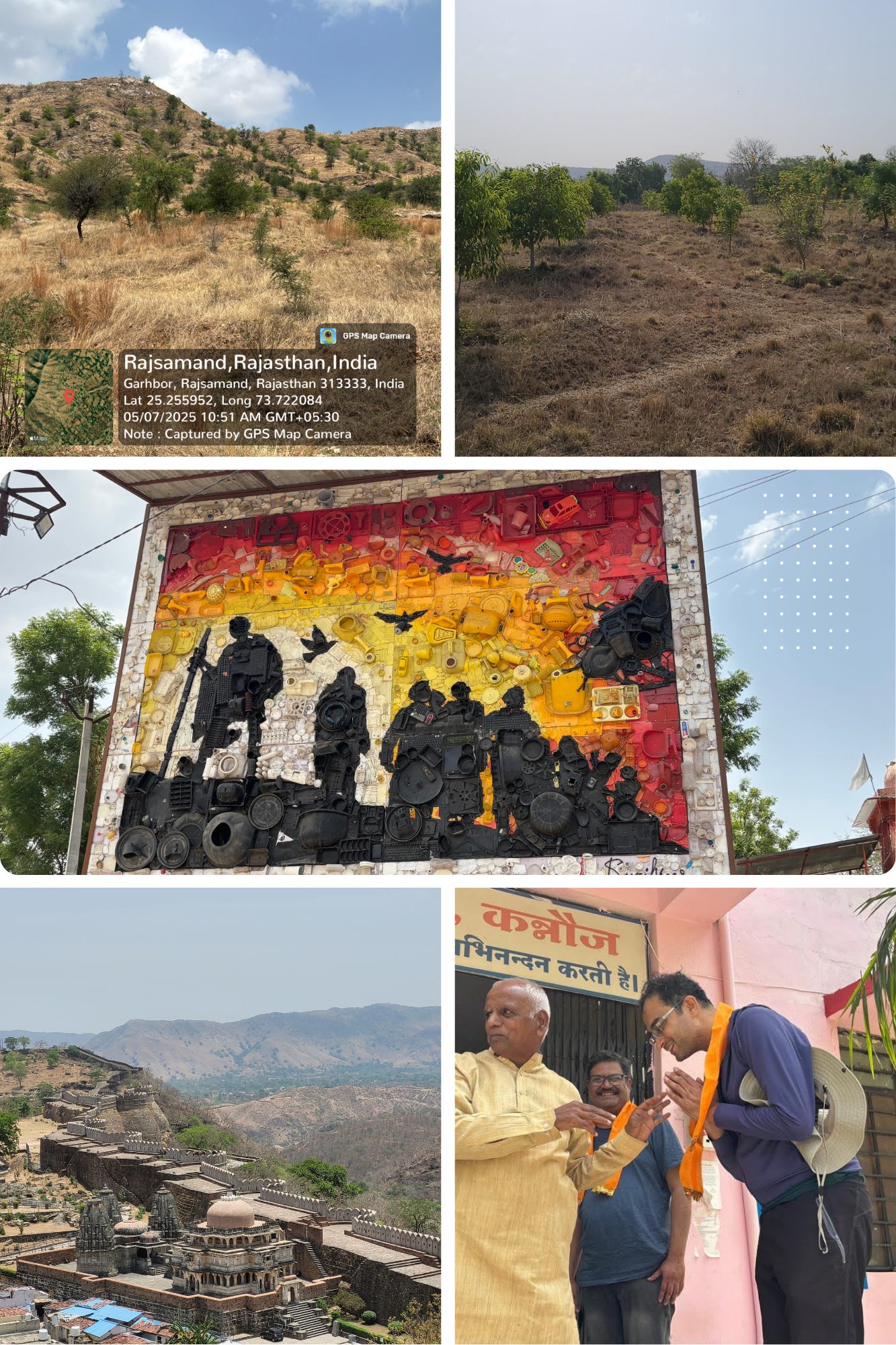
The past quarter, our team hit the roads in Rajasthan, journeyed through Bhim, Chittorgarh, and Kumbhalgarh, visiting partners’ restoration sites and spending time with the communities that are nurturing them. From hilly pastures to watershed projects, the landscapes were as diverse as the learnings they offered.
Here’s what stood out:
People-power drives progress. Sites with strong community ownership consistently show better survival and upkeep. Inclusion, trust-building, and fair benefit-sharing are non-negotiables.
Smart ops, simple methods. Whether it’s refining planting density, introducing multiple planting techniques, or improving nursery systems, the shift is toward lean, local, and efficient models.
Fire protection is critical. Many plantations have seen setbacks due to avoidable fires. Better awareness, community engagement, and fire line planning are key priorities.
Restoration is long-term work. Progress is visible—but nature takes its time. Healthy saplings, natural regeneration, and improved soil and water conditions hint at the transformation underway.
These visits reminded us that restoration is not just an environmental task—it’s a social process. And as we prep for the scaleup, the goal remains the same: growing roots, both in soil and in community.
Regenerating Rajasthan (VCS 5399)
We are delighted that our project has received “Insurable by Artio” status, meaning that investors can access carbon credit insurance on this project. This is a key step for overall risk mitigation and improving the bankability of the project.
Project validation is ongoing, auditor visit has been completed and we look forward to completing the project registration process in the coming quarters.
Medius Earth Powers Titan Vanam
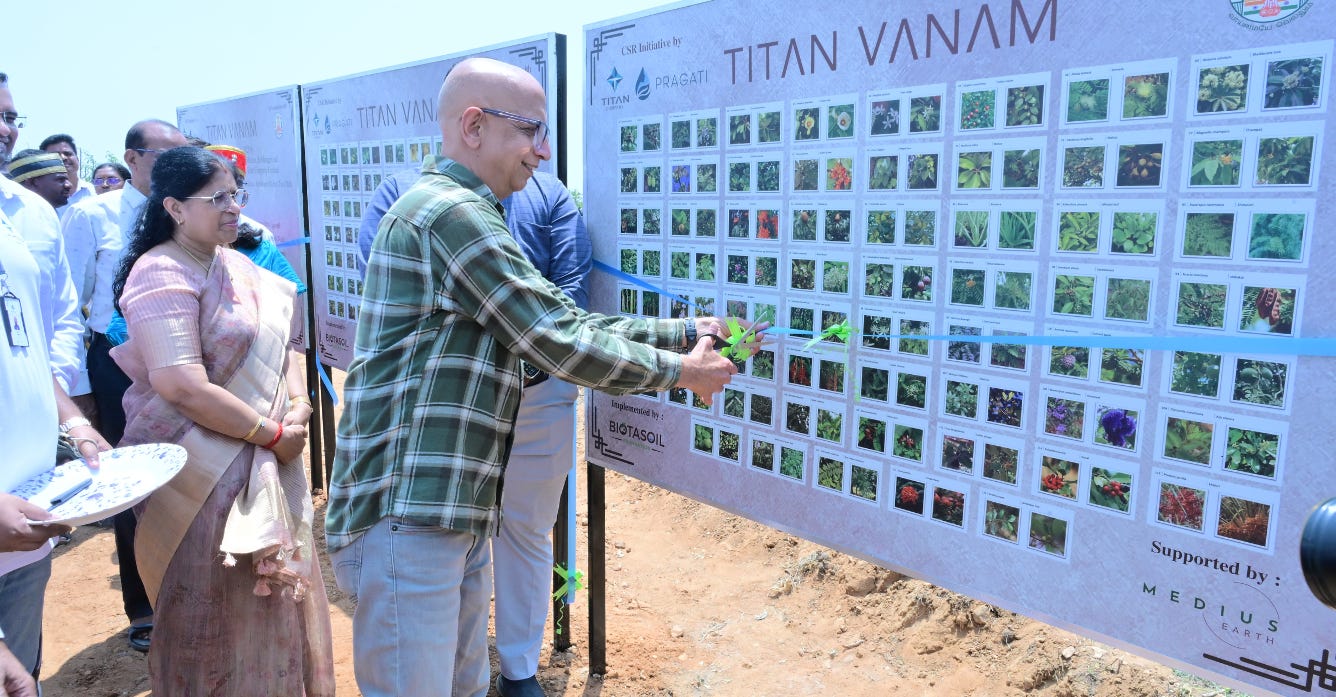
We're proud to announce our role as the technical partner for Titan Vanam, a groundbreaking 45-acre afforestation initiative in Hosur, Tamil Nadu. Our comprehensive technical contributions include ecological assessments identifying 241 existing plant species, invasive species management, soil restoration using organic amendments and beneficial microbes, bio-fencing design, and species selection expertise encompassing rare varieties like Gloriosa superba and endangered species conservation areas. The project was officially inaugurated in April 2025 with participation from Titan leadership, district officials, and forest department representatives.
Tune In: Medius Earth on "The Voice of Generation Climate"
In our latest podcast feature on "The Voice of Generation Climate," our Founder & CEO, Pradyot Porwal, and CIO Andrew MacCormack sat down with Anirudh Gupta (Founder, Climes) to explore this very question and reveal the insights driving Medius Earth's mission.
We talked about: Our approach to large-scale land restoration, Beyond carbon, Navigating the complexities and Building trust, ensuring transparency
Advisor Spotlight: Prof. N.H. Ravindranath on Forests & Climate Action
In Episode 4 of The Boring Climate Podcast, veteran climate scientist and Medius Earth advisory board-member Prof. N.H. Ravindranath offers a powerful reminder of the role forests play in India's climate resilience. He breaks down the latest scientific models used to assess and predict climate change impacts on forest ecosystems and emphasizes the urgent need for protection and regeneration. Prof. Ravi cautions that inaction today could lead to irreversible consequences—not just for biodiversity, but for millions who depend on forest landscapes. His insights strengthen Medius Earth’s conviction in community-led, science-backed restoration work.
From the news
An informative TED talk (06 July 2025) from Al Gore countering the recent climate discourse of “Climate Realism”.
India’s Carbon Market (ICM): The most recent draft emissions targets for select industries for the CCTS were published by the ministry in June 2025. The government continues to make progress towards operationalizing the offset mechanism towards the end of 2025 and compliance mechanism by H2 2026.
Robust Credit Retirements (read here): In Q1 2025, carbon credit retirements remained strong at 54.56 million, closely matching issuances (55.63 million), signalling a market nearing negative net issuance for the first time. This reflects growing demand for quality credits, with 60% of retirements from the "Goldilocks Vintage" (3–5 years old), seen as a marker of quality.
Q2 was a quarter of dominating geopolitics which are reshaping the world and its priorities meaningfully. The popular narratives are changing. However, the bio-geo-chemical and physical processes that result from the human economy continue, leading to dissonance between what’s done and what’s ought to be done. Narratives are fickle, physical realities are not.